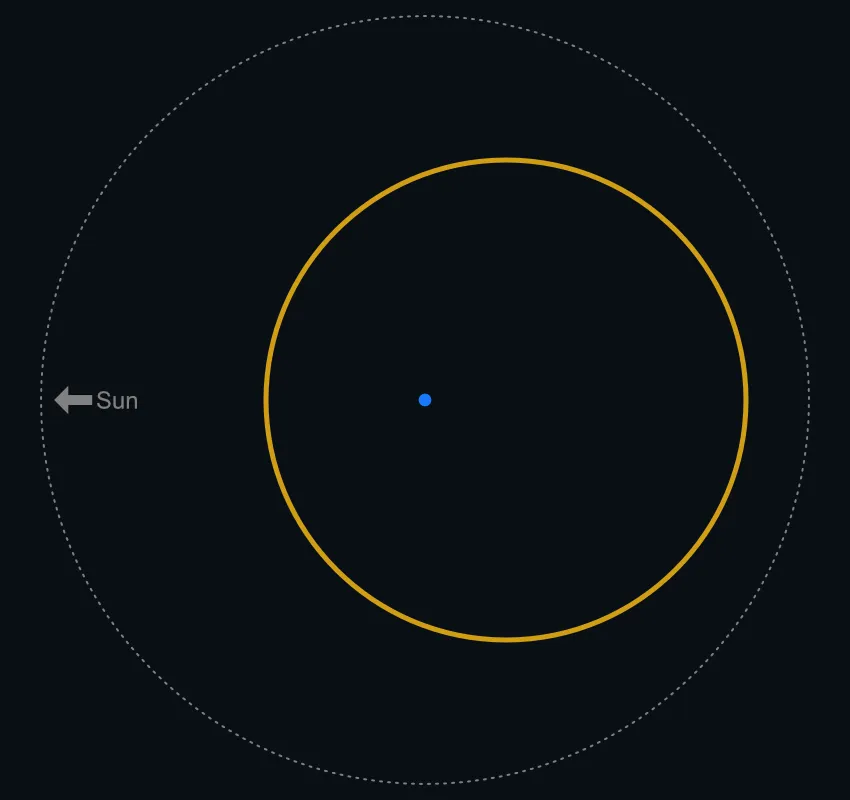
Earth (pale blue dot), the moon's orbit (grey dashed circle), and Earth's exclusion zone (yellow circle), drawn to scale. Earth's exclusion zone is nearly spherical but centered 81,000 km anti-sunward of Earth's center.
The biggest challenge for a space combat game is to make the game tactically interesting. I remember the old TIE Fighter game let you fly around fleets of capital ships, which provide a sort of terrain plus a wealth of targets. More recently, Nebulous: Fleet Command stages its battles in asteroid fields, which similarly provide terrain that blocks sensors and require you to maneuver your ships around to get a good line of sight on your targets.
Real space is mostly empty, so where does terrain come from? In Protocol Era, it’s provided by limiting access to each astronomical body.
Local gravity must be below some threshold for a faster-than-light (FTL) jump to be possible. Get close enough to a body, gravity rises above this threshold, and the jump doesn’t work. The actual rule, in the setting’s physics, is that the local gravity must net to the threshold or less for a jump to be possible, and that has to hold along the whole path of the jump. The volume of space where jumps are not possible is known as a body’s exclusion zone.
Initially, each body had its own jump limit, which was measured in multiples of its planetary radius. That was always a shorthand for a gravitational value, but it gave me something easy to work with in the beginning. I started with 50 radii as a nice round number. Gravity at 50 Earth radii is about 0.0004 g, which seems like a fine value until you start looking at other bodies in the solar system.
For the sun in particular, a 0.0004 g threshold creates a zone that extends well beyond Earth’s orbit. I specifically wanted battles where ships jumped relatively close to Earth-like planets, so I knew that the size of the exclusion zone had to come down. I tried a local threshold of 0.001 g (also known as the “milli-gee” or “millig” threshold because it is one one-thousandth of Earth’s surface gravity) and found that the milli-gee threshold has some interesting repercussions.
The sun’s exclusion zone extends more than 116 million km from its center. That’s big enough to include the orbits of both Mercury and Venus. Interestingly, both Mercury and Venus create pockets between themselves and the sun where the net local gravity is below the threshold. Unfortunately, jumps cannot cross the sun’s exclusion zone to reach these pockets, so they’re more of a curiosity than a useful fact.
Earth’s exclusion zone is about 500 times smaller and well inside the moon’s orbit (see above illustration). The sun’s gravity is still significant at the distance of Earth’s orbit. That means that while Earth’s zone is nearly spherical, it’s not centered on Earth — the sphere’s center is about 81,000 km anti-sunward. The sphere has a radius of 240,000 km (Earth’s diameter is about 12,600 km), but because Earth is off-center, the sunward face is about 159,000 km from the planet’s center. The zone is 226,000 km out at the terminator. The anti-sunward side stretches to a maximum distance of 320,000 km. The sunward side is twice as close as the anti-sunward side, which matters a great deal for how far an attacker must travel to cover the distance between their jump point and low Earth orbit. The exact jump point depends on the sun’s own exclusion zone, the relative positions of the planets, and other facets of solar system geometry — a subject for a future post.
Similar to the sun, Jupiter’s exclusion zone encompasses its closest satellites, including the Galilean moons of Io, Europa, Ganymede, and Callisto. If there’s a helium-3 refinery orbiting Jupiter, then cargo ships have to burn across its exclusion zone to reach the facility. It takes a ship burning at 0.5 g about 14 hours to cross Jupiter’s exclusion zone, compared to about 3.5 hours for Earth’s. The cargo ships have to cross the zone again on the way out, and pirates and privateers may lie in wait behind one of those moons. There’s plenty of time for an aggressor to run down a slower cargo ship before it can jump away.
The exclusion zone opens many interesting tactical options — it creates a kind of “space terrain” without using asteroids or other ships. We already talked about the option for piracy at gas giants. Another dilemma is put to commanders tasked with defending worlds like Earth. They can position their ships in a low orbit, which restricts their ability to maneuver when an attack appears at the jump limit. They can, however, execute maneuvers in secret, with Earth blocking the enemy’s view of their ships for significant periods of time. Alternatively, the defender can position their ships in a high orbit, which makes it easy to consolidate forces at a lower altitude but all of the course changes are visible to their opponent.
I’m honestly not sure which approach is better, so I left it as a matter of doctrine within the setting. It’s one of the first things I plan to simulate once the initial game is built out, and hopefully it holds. The different approaches give us tactical depth in a space combat game.